
A complete system of machinery used in the production of grape juice is set up so that fresh grapes can be processed into grape juice; this system usually includes various stages such as the transport of the raw material, washing, crushing, juicing, filtration, blending, homogenization, deaeration, sterilization and filling. The way in which the equipment is arranged may differ according to the type of product, the properties of the raw materials and the size of the production.
Since we manufacture equipment for food processing, we offer custom solutions for grape juice production lines which are designed to meet our customers’ particular requirements such as the types of raw materials, the desired production capacity, the product standards, the layout of the facility, and the packaging needs, so that companies can set up a full processing system covering the whole process from handling of the raw materials to packaging of the final product.
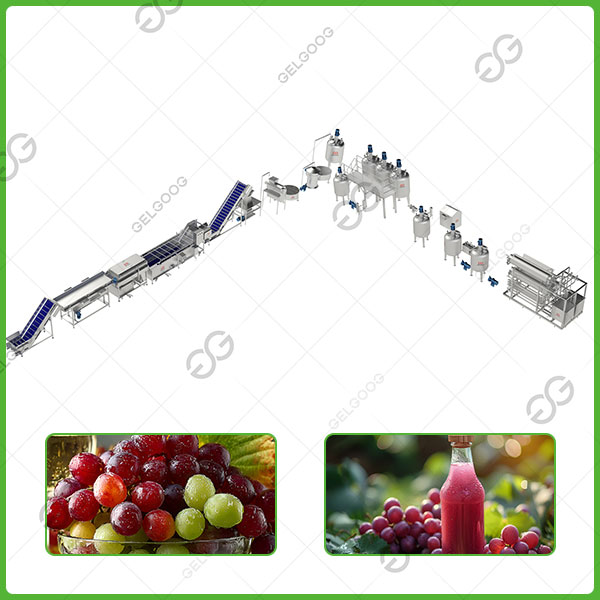
The process to be followed in the grape juice production line must be decided according to the type of grape, its degree of maturity, and the specifications of the final product; the industrial-scale grape juice processing procedure is set out below.
1. The reception of grapes and the sorting of the raw materials
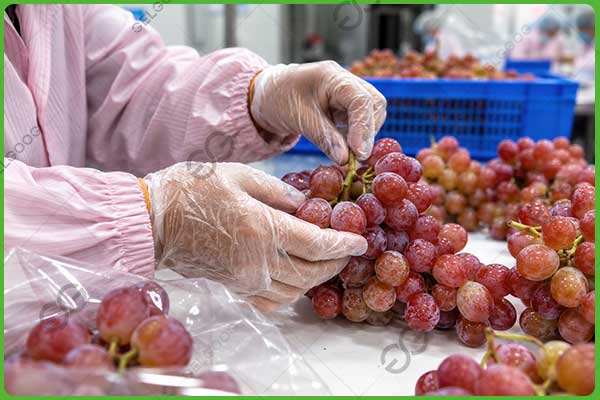
When the grapes arrive at the facility they have to be inspected and sorted. The staff should take out any grapes that are rotten, moldy, unripe or obviously contaminated, as well as examine the ripeness, sugar content and freshness of the raw material.
2. Grape Washing
The grapes are fed into the washing machinery after having been sorted, in order that the soil, dust and other impurities on their surface may be eliminated. For the particular type of raw material, it may be necessary to choose either a bubble washer or a combined washing system. When washing the grapes, it is important to properly regulate both the intensity of the water flow and the speed at which they are conveyed in order to avoid subjecting the grapes to too much pressure or causing them to be crushed.
3. Destemming and Crushing
After washing, the grapes are usually destemmed and moderately crushed. Destemming avoids the grape stems going on to later stages of processing, since this would increase the number of possible sources of unpleasant off-flavours; crushing aids in the release of the juice from the pulp and thus improves the efficiency of the following pressing process.
4. Grape Juicing
Juicing is a major stage in the process of producing grape juice. After having been crushed, the grapes are fed into the pressing machinery, in which mechanical pressure is used to separate the juice from the skins, the seeds, and all the other solid residues.
In large-scale grape juice making machine the juicing equipment must be well integrated with the conveying and filtration systems both before and after it; otherwise the processing capacity of any single piece of equipment would become a bottleneck and thus impair the operational efficiency of the entire production line.
5. The filtration and clarification of juice
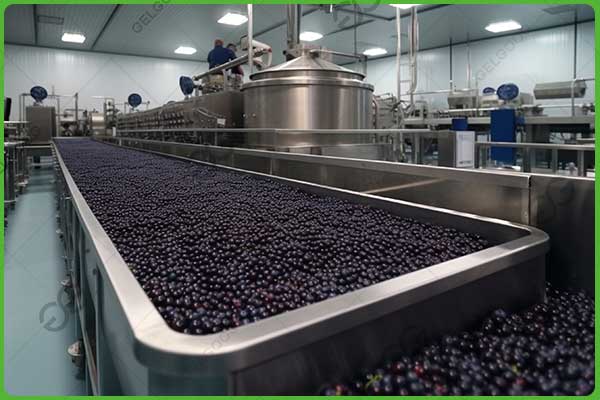
Freshly pressed grape juice generally consists of fine pulp particles, fragments of grape skin, and suspended solids and therefore has to be filtered or clarified depending on the requirements for the final product.
6. Blending, homogenisation and deaeration
Filtered grape juice may be blended in accordance with specific product formulations; for example, by altering the ratio of sugar to acid, by mixing different batches of juice, or by adding ingredients that meet the requirements of local regulations, depending on the desired product position. In the case of pure grape juice, the formulation has to follow the applicable product standards and no ingredients should be added arbitrarily.
In the case of products in which better suspension stability is required, a homogenizer can be used to achieve a more even distribution of the particles in the juice. Deaeration equipment is employed in order to decrease the amount of dissolved gases, thus reducing the risk of oxidation and improving the colour and flavour stability of the final product.
Homogenization and deaeration are not necessary in all cases; whether or not they are carried out should be decided according to the type of grape juice, the particular processing requirements, and the quality desired in the final product.
7. Pasteurization and Filling
After the initial processing, the grape juice must be subjected to suitable heat treatment or to some other validated sterilisation procedure in order to manage the microbiological risks. The usual methods are pasteurisation or high-temperature, short-time (HTST) treatment, these being adapted to the particular product and packaging system.
Equipment Features of Grape Juice Production Lines
1. Customized Production Solutions
As the sources of raw materials, the desired production capacity, and the way in which the product is positioned differ from one business to another, we custom design grape juice production lines to meet each customer’s particular needs. To avoid capacity inefficiencies resulting from mismatched equipment, we make sure that the equipment used covers all the necessary stages—washing, juicing, filtration, sterilization, and filling.
2. Various levels of automation
Grape juice production lines may be set up as either semi-automated or fully automated ones, depending on the investment budget and the scale of production. Fully automated systems are capable of incorporating conveying, pumping, temperature control, liquid-level monitoring, and other control systems, which in turn reduces the need for manual labour and ensures a higher degree of consistency in the way the process is carried out.
3. A focus on food hygiene and maintenance
The parts which come into direct contact with the juice are made from food-grade materials, for example 304 stainless steel, a material that conforms to the applicable industry standards. The design of the equipment also places a focus on various factors including secure piping connections, efficient drainage, the removal of ‘dead zones’ (areas that are difficult to clean), and ease of maintenance. Where necessary, an automated Clean-in-Place (CIP) system can be included in large-scale liquid processing systems.



Reviews
There are no reviews yet.