
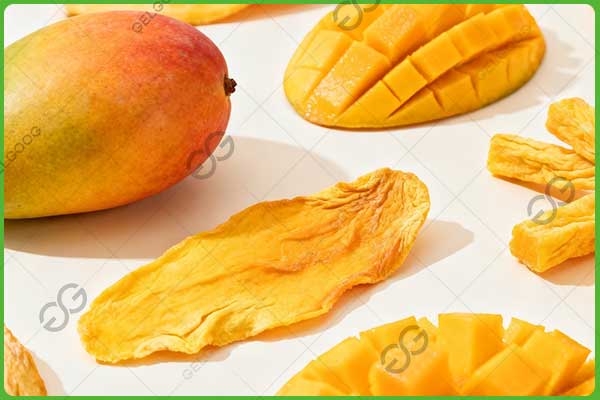
Dried mango is a fruit snack which is made from fresh mangoes via a number of processing steps and is a product which has considerable appeal and real potential for growth. If you’re an investor looking at getting into the mango deep processing business then setting up a dried mango processing factory will require more than just the right production equipment. You’ll also need to consider a number of other factors such as the availability of raw materials, the layout of the facility, the processing recipes, the product you’re going to position and the sales channels you’re going to use. Good initial planning will go a long way to helping a business to control its investment, improve its productivity and maintain the quality of its product.
Processing Workflow for Dried Mango
The processing workflow for dried mango primarily consists of the following steps:
Selection and washing of raw materials — Peeling and slicing — Soaking in sugar solution — Color preservation — Drying — Cooling — Packaging
What needs to be considered in setting up a dried mango processing p factory?
- Raw material supply and procurement costs
Raw materials are of course a major influence on both the cost of production and the quality of the final dried mango product. You need to look at the scale of mango growing in the area, the main varieties grown, the season of harvest and the prevailing market purchase prices prior to setting up a plant. - Factory Area and Layout
The factory layout should be based on the anticipated production capacity, the number of pieces of equipment and the production process. The factory should be divided into zones: raw material reception, washing and peeling, slicing, pre-processing, drying, cooling and packaging and finished product storage. - Product Formulation and Market Positioning
Before you go any further and start looking at equipment, you need to be absolutely clear in your mind as to what type of dried mango you’re after. Is it the traditional sweetened dried mango? A low sugar dried mango? A dried mango with no additives at all? A dried mango for a particular export market?
Different products have different requirements in terms of sugar, acidity, colour, texture (softness/ firmness) and moisture so it is definitely worth doing a number of formulation trials prior to going into full production to work out the right raw material pretreatment, the right drying parameters and the right quality specifications for the final product. - Selecting Appropriate Processing Equipment
Equipment specification should be driven by the required production capacity, the type of product and the level of automation required. The key equipment is a washer, peeler, slicer, pre-treater, dryer, cooling conveyor, metal detector and packer. - Investment Budget and Energy Costs
To set up a dried mango processing plant you need to work out the full cost of the operation. This would include the cost of the equipment, the cost of the plant renovation, the cost of the raw material, the cost of labour, the cost of the packaging, the cost of water and electricity and the cost of fuel. - Sales Channels and Market Demand
Setting up a factory is more than just planning for production, you also have to plan in advance for the sale of your product. You can choose from a variety of sales channels (supermarkets, food wholesalers etc) depending on your market.
Setting up a dried mango processing factory is an investment project which will require a great deal of planning. Every aspect of the operation from the sourcing of your raw materials through to the design of your facility, your processing recipes, your equipment and your sales channels is going to have a bearing on the way the plant operates in the long term. If you have any problems at all in the course of setting up the plant, please don’t hesitate to get in touch.