
Apple chips are a type of snack food made from fresh apples through processes such as washing, slicing, and dehydration. Compared to fresh apples, apple chips have had most of their moisture removed, making the product lighter and easier to store and transport.
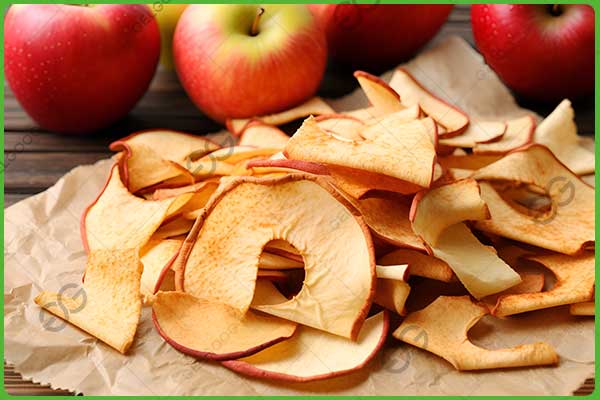
How are crispy apple chips made?
Key processing steps for apple chips:
The complete production process for apple chips can be adjusted based on product positioning. For products made using standard drying methods, the core process typically involves:
Apples → Washing → Slicing → Drying → Cooling → Packaging
Dehydration is a critical step in the overall production process.
Hot-air drying is a common method in industrial production. Once apple slices enter the drying equipment, continuous hot-air circulation causes the moisture within the product to gradually evaporate.
For factories with continuous production lines, continuous hot-air drying equipment can be used; this allows apple slices to enter the drying zone at a set speed and undergo dehydration in stages.
In addition to traditional hot-air drying, there is another category of apple slices produced using vacuum freeze-drying technology.
The fundamental principle of freeze-drying differs from that of conventional drying. After being sliced, the apples are first frozen to turn their moisture into ice; the moisture is then gradually removed via sublimation in a vacuum environment.
Simply put:
Conventional drying primarily relies on the evaporation of liquid water under heat, whereas freeze-drying involves the direct sublimation of ice under vacuum conditions.
Due to the differing processing environments, the resulting apple slices exhibit distinct differences in appearance, structure, texture, and cost.
What is the difference between hot-air drying and freeze-drying?
1. Different processing temperatures
Hot-air drying relies on heated air to transfer heat, meaning the product undergoes a process involving significant heating.
Freeze-drying, on the other hand, involves vacuum dehydration following low-temperature freezing; during the dehydration phase, the product is not exposed to high-temperature environments for extended periods as it is in traditional hot-air drying.
2. Differences in texture
Hot-air dried apple chips typically offer a distinct crispness, though their internal structure is affected by thermal shrinkage.
Freeze-dried apple slices, in contrast, tend to develop a loose, porous internal structure, often providing a noticeable “melt-in-the-mouth” sensation or a light, airy crispness.
3. Differences in appearance and raw material form
During hot-air dehydration, apple slices undergo a certain degree of shrinkage.
In the freeze-drying process, since moisture is primarily removed via sublimation, the product’s original form is generally better preserved, and its color and structure more closely resemble those of fresh fruit.
4. Differences in equipment investment and production costs
Hot-air drying equipment features a relatively mature design and strong continuous production capacity, making it suitable for large-scale processing and widely used in the production of mass-market apple chips.
In contrast, freeze-drying equipment involves processes such as refrigeration, vacuum application, and sublimation drying; this entails higher equipment investment, and the overall processing cycle is typically longer than that of conventional hot-air drying.If you would like to know which type of apple chips processing equipment is best suited for you, please leave us a message.