
After harvesting, oranges vary in size, weight, appearance, maturity, and internal quality; consequently, commercial processing typically requires a preliminary grading stage. Scientific grading allows oranges of similar quality to be grouped into the same grade, thereby meeting the requirements for various end uses. So, what are the orange grading standards?
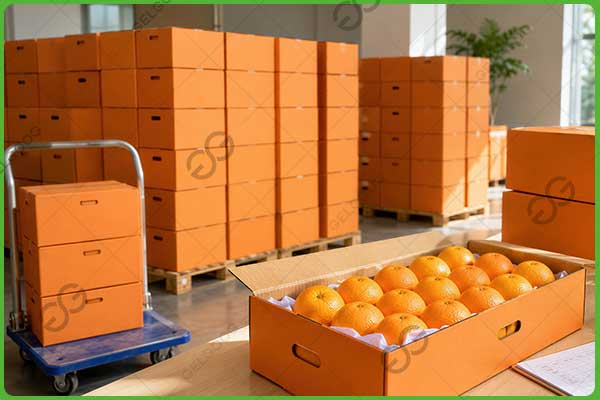
What are the common oranges grading standards?
Orange grading typically relies on a combination of multiple indicators rather than a single one, tailored to the product’s market positioning. Common criteria include size, weight, color and maturity, sugar content, surface blemishes, and internal quality.
1. Grading by Size
Size is one of the most intuitive and common criteria for grading oranges. Fruits of varying sizes can be categorized into different grades based on their transverse diameter, longitudinal diameter, or overall fruit diameter.
In actual production, specific size ranges are determined based on the orange variety, target market, and customer requirements; there is no universal size standard applicable to all varieties.
2. Grading by Weight
Grading by weight is another highly practical method. Compared to simply measuring diameter, weight reflects an orange’s overall size and flesh content to a certain extent.
It is important to note, however, that weight and size are not exactly equivalent. Two oranges with similar diameters may differ significantly in weight due to variations in density, peel thickness, and water content. Consequently, in scenarios requiring high precision, a combination of size and weight measurements may be used.
3. Grading by Sugar Content
For consumers, the size of an orange does not necessarily indicate the quality of its taste. Consequently, in the production and sale of premium fruit, sugar content serves as a crucial indicator.
Generally speaking, higher sugar content suggests greater potential for sweetness; however, the actual taste cannot be determined by sugar content alone—factors such as acidity, ripeness, and variety characteristics must also be considered.
4. Grading based on color and maturity
While orange peel color can reflect maturity to some extent, color characteristics vary across different varieties and growing regions; therefore, a darker color does not necessarily indicate superior quality.
In industrial production, machine vision systems can be used to assess peel color, color uniformity, and localized color anomalies, allowing the fruit to be sorted into categories based on color ranges.
5. Grading based on surface defects
Surface defects are a crucial criterion for grading oranges intended for the fresh market.
Common issues include abrasions, scratches, skin blemishes, sunburn, insect damage, and rot or mold.
Oranges can be classified into different grades based on the area, number, location, and severity of these defects.
It is important to note that minor cosmetic blemishes and rotten fruit should not be lumped into the same category. Oranges with minor surface defects may still be suitable for processing, provided their internal quality meets standards; conversely, fruit that is rotten, moldy, or exhibits significant quality issues should be promptly discarded.
How should different grading standards be combined?
In actual orange processing plants, relying on a single standard often fails to fully reflect product quality. Consequently, a multi-indicator grading approach is more commonly adopted.For instance, an automated orange grading line might first wash the oranges, inspect their appearance using a vision system, and then sort them based on size or weight. If customers have stricter requirements regarding internal quality, non-destructive testing modules—such as those for measuring sugar content—can also be integrated.